


The Tiny Least Killifish: A Complete Care Guide
The Complete Guide to Least Killifish: Perfect Nano Aquarium Residents
If you’re looking for the ultimate nano fish that combines personality, ease of care, and fascinating behavior, let me introduce you to one of my absolute favorites: the Least Killifish. Despite what the name suggests, these tiny swimmers aren’t actually killifish at all, but livebearers related to mollies and guppies. I’ve been breeding these remarkable little fish for over a decade, and they never cease to amaze me with their adaptability and charm.
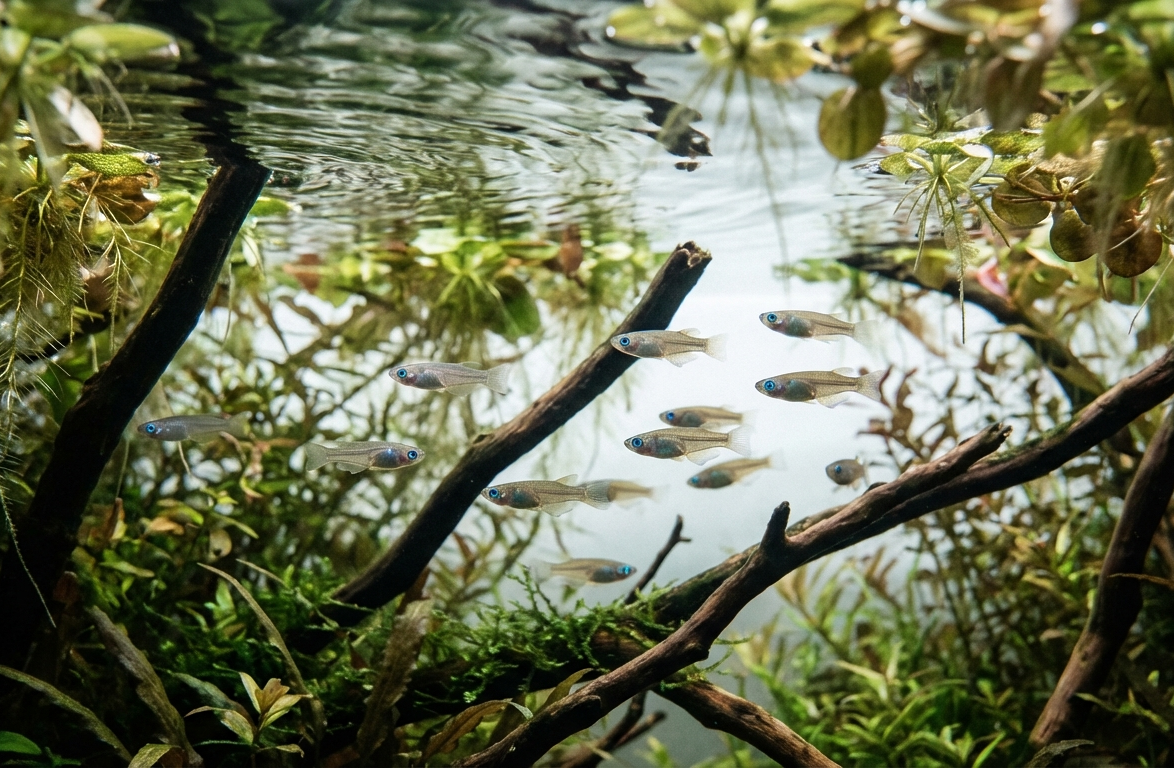
At barely half an inch long for males and three-quarters of an inch for females, Heterandria formosa holds the title of the smallest livebearer in North America and one of the tiniest fish you can keep in an aquarium. Don’t let their diminutive size fool you though. These fish pack incredible personality into their miniature frames and make perfect inhabitants for nano tanks as small as 5 gallons. Their peaceful nature, hardiness, and unique reproductive strategy make them ideal for both beginners and experienced aquarists who appreciate the finer details of fishkeeping.
Meet the Least Killifish: Tiny but Mighty
The Least Killifish originates from the southeastern United States, particularly Florida, Georgia, and South Carolina, where they inhabit slow-moving streams, marshes, and heavily vegetated ponds. In the wild, you’ll find them darting among aquatic plants and algae, feeding on microscopic organisms. Their natural habitat gives us valuable clues about how to keep them thriving in captivity. These fish have evolved to handle fluctuating water conditions, making them surprisingly resilient for such small creatures.
What makes Heterandria formosa truly special is their superfetation, a rare reproductive trait where females carry multiple stages of embryos simultaneously. This means a single female can give birth to one or two fry every few days rather than dropping a large batch all at once. Males display subtle but beautiful coloring with rows of dark spots along their flanks and hints of yellow and red in their fins. Females are slightly larger and more robust, with a characteristic gravid spot that’s almost always present since they’re perpetually pregnant once mature. The scientific community has studied these fish extensively because of their unique biology, and they’ve become important models for understanding livebearer evolution.
Setting Up the Perfect Tank for Your Fish
Creating an ideal environment for Least Killifish doesn’t require elaborate equipment or a massive investment. A 5-gallon tank works perfectly for a small colony of six to eight individuals, though I prefer 10 gallons or larger to create a more stable ecosystem and allow for population growth. The key is providing plenty of plants, both floating and rooted, which serve multiple purposes: they offer hiding spots for fry, help maintain water quality, and provide surfaces for biofilm growth that these fish love to graze on throughout the day.
Water parameters for Least Killifish are forgiving, which is great news for nano aquarium enthusiasts. They thrive in temperatures between 68-78°F (20-26°C), though they can tolerate slightly cooler conditions during winter months. I maintain my breeding tanks at around 72-74°F for optimal health and reproduction. A pH range of 6.5-8.0 works well, and moderate hardness is fine. Here’s what I recommend for tank equipment:
- Gentle sponge filter or small hang-on-back filter with reduced flow
- Low-wattage heater (25-50 watts for a 10-gallon tank)
- Basic LED lighting sufficient for plant growth
- Dense planting with java moss, guppy grass, or hornwort
- Floating plants like water sprite or salvinia
- Fine-leaved plants for fry refuge
The most important aspect is avoiding strong currents. These fish come from still or slow-moving waters and can become stressed by powerful filtration. I always baffle my filter outlets or use sponge filters exclusively in tanks housing Least Killifish. Substrate choice is flexible, though I prefer sand or fine gravel that won’t trap uneaten food particles.
Feeding Your Least Killifish the Right Way
Feeding such tiny fish requires a different approach than feeding standard community fish. Their mouths are absolutely minuscule, so food particle size matters tremendously. In the wild, they feed continuously on microscopic organisms, aufwuchs (the biofilm that grows on surfaces), tiny insects, and zooplankton. Replicating this diet in captivity ensures healthy, colorful fish with strong immune systems and successful reproduction.
I’ve found that the best feeding strategy combines multiple food types offered in small amounts several times daily. High-quality nano fish foods formulated specifically for small species are essential. The Nano Fish Food Grow Up Meal is perfectly sized for Least Killifish, with particles small enough for even newborn fry to consume. This eliminates the need for separate fry foods, which simplifies care considerably. I feed my colonies twice daily with this food, offering only what they can consume in about two minutes.
Supplementing with live or frozen foods produces the best results:
- Baby brine shrimp (excellent for conditioning breeders)
- Daphnia (small specimens only)
- Microworms
- Vinegar eels
- Crushed flake food (high-quality spirulina or color-enhancing varieties)
The beauty of keeping Least Killifish in well-planted tanks is that they constantly graze on naturally occurring microorganisms between feedings. This natural foraging behavior keeps them occupied and contributes significantly to their nutrition. I’ve noticed that fish kept in heavily planted tanks with mature biofilm show better coloration and more consistent breeding compared to those in sterile environments.
Breeding Least Killifish in Your Home Aquarium
Here’s where things get really exciting. Breeding Least Killifish is remarkably easy, almost inevitable if you keep males and females together in suitable conditions. Unlike many livebearers that produce dozens of fry at once, female Least Killifish give birth to one to three tiny fry every few days due to their unique superfetation. This steady trickle of babies means you won’t suddenly find yourself overwhelmed with hundreds of fish, a common problem with guppies or mollies.
The gestation period for each batch of embryos is roughly three to four weeks, but since females carry multiple stages simultaneously, you’ll see new fry appearing regularly once breeding begins. Newborn fry are incredibly small, barely visible at first, but they’re surprisingly independent and immediately begin foraging for food. This is where heavily planted tanks become crucial. The dense vegetation provides countless hiding spots where fry can avoid being eaten by adults or other tankmates, though Least Killifish show less predatory behavior toward their young compared to many livebearers.
To maximize fry survival, consider these breeding tips from my experience:
- Maintain a ratio of two or three females per male to prevent female harassment
- Keep the tank densely planted with fine-leaved plants
- Provide floating plants where fry tend to congregate
- Feed high-quality foods multiple times daily to well-fed adults
- Maintain stable water parameters with regular small water changes
- Avoid keeping them with larger fish that might eat fry
The growth rate of Least Killifish fry is slow compared to other livebearers. They reach sexual maturity at about three to four months, though this varies with temperature and feeding frequency. Males mature slightly faster than females. I’ve found that feeding Nano Fish Food Grow Up Meal from birth accelerates growth while ensuring proper development. The small particle size means fry can eat the same food as adults, simplifying the feeding routine considerably.
Frequently Asked Questions About Least Killifish
How many Least Killifish can I keep in a 5-gallon tank?
You can comfortably keep six to eight Least Killifish in a well-filtered 5-gallon tank. Given their tiny size and low bioload, they won’t overcrowd the space. However, if you plan to let them breed, consider starting with fewer fish or upgrading to a 10-gallon tank to accommodate population growth.
Can Least Killifish live with other nano fish?
Absolutely! They’re peaceful community fish that do well with other small, non-aggressive species like Ember Tetras, Chili Rasboras, or small shrimp like Cherry or Amano shrimp. Avoid keeping them with anything large enough to eat them, such as adult Angelfish or larger Gouramis.
Do Least Killifish need a heater?
If your room temperature stays consistently between 68-78°F, a heater isn’t strictly necessary. However, I always recommend using one to prevent temperature fluctuations, which can stress fish and compromise their immune systems. A small 25-watt heater works perfectly for most nano tanks.
How long do Least Killifish live?
With proper care, Least Killifish typically live two to three years, though some individuals may reach four years. Their lifespan is respectable for such small fish, and their continuous breeding means you’ll always have multiple generations in your tank.
What’s the best way to catch Least Killifish without stressing them?
Due to their tiny size, use a fine mesh net and move slowly. I prefer using a clear plastic container to gently corral them rather than chasing them with a net, which causes less stress. Their small size makes them surprisingly quick and agile!
Conclusion
The Least Killifish represents everything wonderful about the nano aquarium hobby. These tiny North American natives prove that you don’t need large tanks or exotic species to enjoy a fascinating, dynamic aquarium. Their manageable size, peaceful temperament, and unique reproductive biology make them ideal subjects for observation and study, while their hardiness ensures success even for relative beginners.
After years of working with these remarkable fish, I’m convinced they’re one of the most underappreciated species in the hobby. They thrive in small spaces, breed readily without special conditions, and display genuine personality despite their diminutive size. Whether you’re setting up your first nano tank or you’re an experienced breeder looking for something different, Heterandria formosa deserves serious consideration. Give them a heavily planted tank, feed them appropriately sized food like Nano Fish Food Grow Up Meal, and maintain stable conditions, and you’ll be rewarded with a thriving colony of these miniature marvels that will bring you years of enjoyment.


Leave a Comment
Your email address will not be published. Required fields are marked *